Reel to reel to digital transfer service
We transfer reel to reel to digital for archives, museums, broadcasters and private collectors. Every tape is played on a calibrated studio machine set up for that specific tape, and the result is an archival-quality WAV file that captures the full content of the tape.
What reel to reel conversion involves
A reel of tape looks simple, but it does not tell you how it was recorded. The speed and the track layout are rarely written on the box, and when they are, the notes are not always right. A good transfer starts by finding out.
Reel to reel tape conversion is more than playback. These are the things that decide whether the digital file is a faithful copy or a compromised one.
Calibrated studio recorder
A high-quality, calibrated studio tape recorder reproduces the sound recorded on the tape accurately across the full frequency range, from low frequencies to high. We calibrate our recorders regularly and verify their frequency response by measurement, so that every frequency is reproduced at the correct level.
Tape speed
Reel-to-reel tapes were recorded at speeds from 15/32 ips on logging recorders up to 30 ips in studios. We always play a tape at the speed it was recorded. The speed can also change in the middle of a tape if the owner recorded new material at a different setting, so we check the whole tape, not just the beginning.
Playing a tape faster than it was recorded, for example at double speed to save time, cannot be fully fixed afterwards. Duration and pitch can be corrected in software, but the noise level rises compared to playback at the original speed, and high frequencies are often lost. At double speed, a 12 kHz tone on the tape becomes a 24 kHz signal, which the playback head cannot reproduce. That is why we never use double-speed playback.
Track configuration
The same 1/4" tape can hold one full-width track, two tracks, four tracks, or eight tracks on multitrack machines. A quarter-track stereo tape carries two programs, one in each direction. If it is played on a half-track head, the second program is picked up as well and plays backwards underneath the first. A full-track mono recording played on a narrower head loses signal level. When the level is raised afterwards, the noise rises with it. The head has to match the tape.
Equalization
The tape itself does not reveal which equalization it was recorded with. Unless the box or other information indicates the curve, we use a standard curve (NAB or IEC) that matches the tape speed. If the tape is known to have been recorded with a non-standard or historical curve, we use that instead. We can play back tapes with any equalization curve.
Noise reduction
Professional and semi-professional tapes were sometimes encoded with Dolby A, Dolby SR or dbx noise reduction. Consumer recorders sometimes used Dolby B. Without a decoder, or with the wrong one, the recording is not reproduced correctly. We identify the encoding and decode it with the matching decoder during the transfer.
Splices, leaders and trailers
Old splicing tape dries out and comes loose, and the tape separates at the splice. A tape without leader cannot be played from the very beginning, because the beginning has to be wound around the take-up reel before playback starts. We repair splices and add missing leader and trailer tape, so the whole recording is played from start to finish.
The process is described step by step in our reel-to-reel digitization guide.
Reel to reel tape conversion at Polartape
Reel to reel digitization starts with inspection. Every tape is checked for physical damage, and its tracks are made visible with a purpose-built viewing device. This shows the track layout directly, so the right playback head is chosen without guesswork. We then determine the speed and adjust the playback head azimuth for that tape. If a tape contains recordings made on different machines, each section gets its own adjustment.
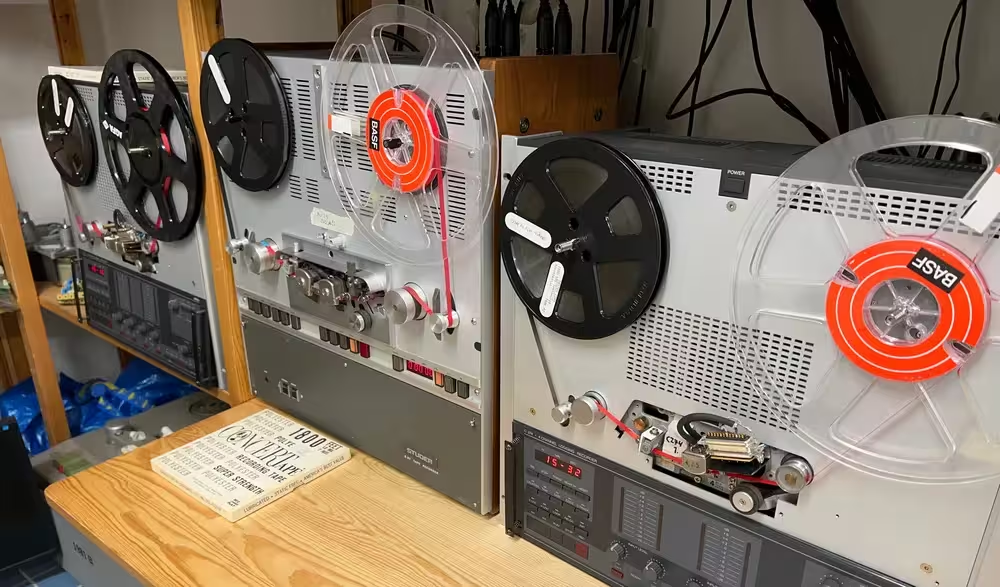
Our main machines are the Studer A820, A810 and B67. Slow-speed tapes are played on Revox C274 logging recorders, and 4-channel and 8-channel multitrack tapes on the Revox C274 and Fostex E8. We digitize 1/4" tape at all speeds from 15/32 to 30 ips.
Read more about our quality process or see the full equipment list.
What you receive
By default, you receive 24-bit / 48 kHz WAV files. Higher sample rates and 32-bit float are available on request. Each mono or stereo recording is delivered as one file. 4-track and 8-track multitrack recordings are delivered as one file containing all 4 or 8 tracks. Every delivery includes technical metadata in AudioMD format and MD5 or SHA checksums for each file.
Trusted by the National Archives of Finland
Our reel-to-reel clients include the National Archives of Finland, for which we have carried out two large-scale digitization projects. See more case studies.
Frequently asked questions
Do I need to know the speed or track format of my tapes?
Which track configurations do you digitize?
- Full-track mono
- 2-track stereo (NAB and DIN/IEC), also with timecode
- 4-track stereo (quarter-track), both directions
- 4-track, 4-channel multitrack
- 8-track, 8-channel multitrack
Which reel sizes can you handle?
Can I send tapes from outside Finland?
Can you handle sticky, damaged or moldy tapes?
Do I get my original tapes back?
Can you handle a large collection?
Tell us about your tapes
Let us know how many reels you have. We will reply with a plan and a cost estimate. Our tape to digital service also covers cassettes and other audio formats.